
Sustainability Every Step of the Way
A Note from Rob
This will be our seventh Benefit Corporation report. And, looking back, we wanted to do things differently this time.
Our past impact reports have been rich with information, but somehow still seemed to fall short of capturing the breadth and depth of the work that goes into our sustainability efforts. So, in this year’s report, you’ll see fewer topics, each with more focus.
We hope that by going deep with specific examples, you’ll see just how driven, exacting, and committed our team is to doing this work. It was hard to choose! There are so many initiatives we could have covered. Hopefully, the examples we’ve selected give you a sense of how we’re constantly working to make our brewery a better place.
We hope the contents of this report make the contents of your next can, bottle, or draft pour of Allagash White taste all the better.
Cheers,
Rob


Part 1
Bringing in Materials
Beer requires a multitude of materials to create. Grain, hops, water, cans, bottles, cardboard carriers, wooden pallets, cleaning materials and more. So, our sustainability journey starts with what ingredients we choose, and how we get them here. Below, you’ll find three tangible ways we’ve reduced our impact.
More and More Maine-Grown Grain
Since 2016, we’ve put a priority on collaborating with local farmers and maltsters to increase the amount of local grain in our beer. The three organizations we’ve worked closest with, and who have had the biggest impact on this pledge are: Maine Malt House, Aurora Mills & Farm, and Blue Ox Malt House. The growth in our use of more Maine-grown and malted grain means grain grown locally, fewer miles of transport, and a closer relationship with our suppliers. In 2021, we hit a milestone when we brewed with over 1 million lbs of Maine grown grain. And, we’re happy to report, 2025 was another milestone years, as we brewed with…
2,025,674 lbs of Maine-grown Grain.
Less Tray, Better Outcome
Our bottled and canned beers come in cardboard trays. When we received those trays, they were at– first wrapped in plastic stretch wrap and then secured with four heavy-duty plastic bands every 25 trays. Working with International Paper, our supplier, we found that not only did we not need plastic wrap, we needed only four plastic bands to keep the entire 2400 trays stable. On top of that, our reconfigured orientation made it possible to ship more trays on a single truck. The result: we shipped the same number of trays using half the trucks.
And we used less plastic while we did it.
Warehouse Relocation
We recently shifted the location of where our warehouse operation was located—from miles away from the brewery to literally across the street. This move, which required quite a few logistical hurdles, ended up reducing our shipping by 20,000 miles per year.
That’s nearly one full trip around the earth.
Rob’s Take
“Close relationships with suppliers always benefit the beer.”

Part 2
Brewing the Beer
Brewing is a complex, precise, resource-intensive process. And the goal is to get the most out of every raw ingredient, using the least possible energy.
Spunding
It’s a funny-sounding word that literally reduces CO2 usage and emissions. During fermentation, we spund our tanks, meaning, we cap them once they reach a set pressure. This captures CO2 that would have otherwise simply escaped into the atmosphere. Capping the tank also requires us to use less CO2 when it comes time to recarbonate that beer for packaging. This single process leads to a savings of over…


De-Aerated Water Usage
Oxygen can ruin the flavor of beer. Tap water is full of oxygen. So, many breweries use beer to prep equipment that beer is about to enter or exit. Think: flushing a pipe or clearing cleaning solution out of a tank. Our de-aerated water system pulls oxygen out of water, so we can purge lines, purge tanks, prep packaging equipment with water, rather than beer—and all the heat, ingredients, and labor that go into it.
Wasting less beer is always a good idea.
Spent Grain & Yeast
In the brewing process, once grain has been brewed with, and yeast has fermented every last drop, they are no longer useful for brewers. They are, however, helpful for other farmers. So, we’ve developed long term relationships with local farmers to make good use of both. Norm, a local cattle farmer, picks up our spent grain and distributes it to farmers across Maine. Paul of Randall Farms picks up our spent yeast and converts it into fertilizer. All told, they help us divert over 5.8 million pounds of grain, and over 1.5 mm lbs of yeast away from the landfill, every year.

Rob’s Take
“Keeping track of every little thing we do makes it possible for us to improve every little thing we do.”
Part 3
Packaging our Beer
Our packaging team puts lots of beer into lots of containers. This process requires large, complex machines, high standards, and involved coordination. In every single step, our team is constantly looking for ways to be more efficient, use fewer materials, and increase our beer’s quality.
Crushin’ It
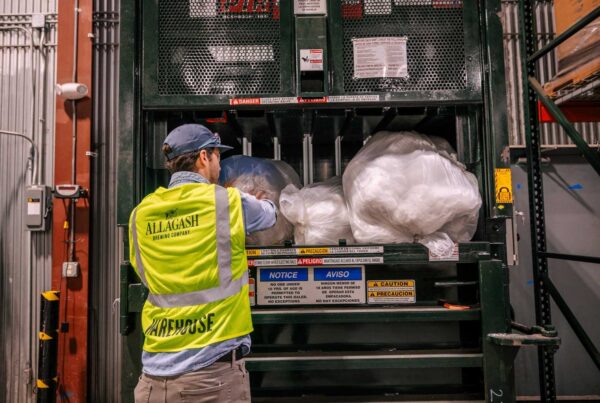
This piece of machinery allows us to crush any unneeded cans into hyper-compressed pucks of aluminum. This helped us remove a giant roll-off trash bin—that had to be hauled away ~twelve times per year—while still recycling 2.5 tons of aluminum last year alone.
That’s roughly 150,000 empty cans.

Grade A Decision
We switched from buying new wooden pallets to lightly-used “Grade A” pallets. Because we use these pallets for transporting kegs, cans, bottles, raw materials, and more, we’ve cut the need for ~10,000 pallets per year with the change.
Awash with Savings
Based solely on changing the nozzles and positioning of how we rinse the outside of our cans after filling, we reduced our water usage by 1.5 gallons per minute, when the canning line is running. It’s one of the many ways we work to reduce our water usage to 3.4 gallons of water per gallon of beer.
That’s half the industry average.

Rob’s Take
“Practices and equipment like these allow us to keep 98% of our waste out of the landfill.”
Part 4
Sending Beer Your Way
The process of getting beer from us, to you, is complicated. There’s timing, coordination, planning, and communication all wrapped into it. In the simplest terms possible, the biggest opportunity is making sure trucks arrive full and leave full. Below, you’ll find a few aspects of that process that we’re proud of.
Full Kegs are Happy Kegs
Rather than owning our kegs, we rent them. So, once a keg of our beer is empty, it simply heads to the closest brewery that is also a MicroStar subscriber. If we owned our own kegs, shipping them out from the brewery would be easy. But getting them back becomes the issue—you’re shipping empty kegs all around the country, rather than re-filling them nearby. For example, last year we would have had to ship back 18 truckloads of empty kegs from CA alone. At 3,100 miles each time.
That’s 55,000 miles those empty kegs didn’t have to travel.

Recycling as a Team
Now in its sixth year of operation, our recycling Co-Op has about 10 consistent members that comprise local grocers and craft breweries. We accept three hard-to-recycle materials that are necessary to the production of beer: #2, #4, and #5 plastics. #2 and #4 comprise mainly of stretch wrap and plastic can carriers, often sourced from PakTech®. Those two types of plastic we collect, bale, and send to Hannaford, our local grocery chain, who then sends it to Trex®, a maker of plastic construction materials. The #5 plastic is primarily from grain bags. Grain bags in good condition, we’ll provide back to our farmer partners for re-use. All others go to Casella, for proper recycling. Since its inception, we’ve recycled well over 180 tons.
That’s about a blue whale’s worth of plastic kept out of the landfill.
Full Truck Reporting
We developed an automated report that provides a weekly update of outbound shipments, highlighting if a trailer could be more full. We then go back and work with our partners to optimize the shipment. In just one year, we increased our number of full trucks by ~15% to an average of 90% of trucks leaving our warehouse full.
That’s 400,000 lbs consolidated onto fewer trucks.

Rob’s Take
“Re-using and using less help the environment and our bottom line. “
Part 5
Constantly Improving as a Company
Breweries are multi-faceted businesses. Beyond brewing, packaging, and shipping, we have: Engineering, Quality, IT, Hospitality, HR, Marketing, Sales, and Finance. That makes for around 130 employees that work year-round to bring fresh, delicious Allagash to you. And, as a company, we want to ensure we’re providing our staff with a great employment experience. This work is never done—we’re always thinking about how we can improve our workplace culture and be a better employer.
Best Places to Work Survey
Our annual employee engagement survey includes topics like trust in leadership, adequacy of working conditions, belief in the company to uphold our values, and more. Every year, a third party conducts an anonymous survey, for all brewery employees. Our HR and leadership teams then use the results to adjust our internal priorities. Since 2013, we’ve invested in this process to collect and understand our employees’ feedback about all aspects of their job—and have continued to make improvements as a result.

The Value of Traditions
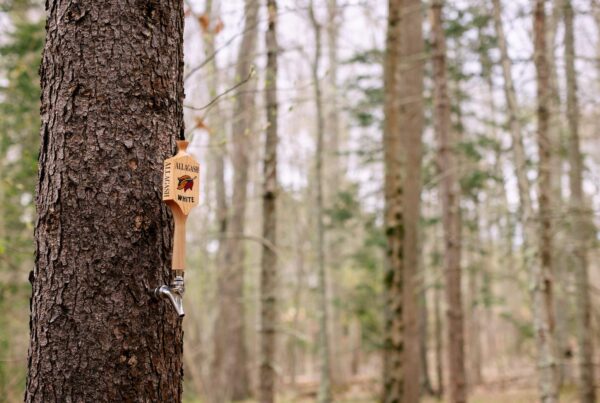
Over time, our company has accumulated more than a few hallowed traditions, ideas which come in from employees throughout the company: our annual employee chili cookoff, to a Pinewood Derby where employees race cars they make themselves, a Hearts of Pine soccer game for employees and their families, Maine Maple Brunch where we feast on a maple themed potluck at the exact time of year the sugar houses are flowing. The list goes on and evolves every year. Beyond that, there are tenure-based traditions that employees look forward to from the moment they’re hired. After five years, employees get a paid trip to Belgium with our founder and brewmaster. At ten years, and every five after that, employees get a month-long, paid sabbatical, to use any way they want, giving time to reflect and recharge.
Fostering Curiosity
We’ve built our core value of “innovation” into every facet of how our business operates. Employees of all tenures, and in all departments, are encouraged to help us define the culture at Allagash and continue to improve. In addition to some of the traditions mentioned above, there’s our Pilot Beer Program, where recipes can come from anyone in the brewery. Sustainability ideas are encouraged and reviewed by our Green Team—a group of employees from every department that continuously asks how we can operate more sustainably. And our Sensory Program encourages employees from across the brewery to learn to evaluate our beer in a way that ensures it retains its award-winning quality.

Rob’s Take
“Allagash employees have voted us as one of the best places to work in Maine twelve times since 2013.”
Part 6
Giving Back With Beer
As a company, we want to maximize the impact of our team to improve the communities that we’re a part of. That impact takes many forms. Our multi-talented employees are particularly generous with their time and skills, volunteering for a wide range of local nonprofits they connect with. And Allagash makes a point of putting significant resources into our corporate philanthropy program, to help great organizations do more good in our community. When you buy our beer, you help us keep all of this good work going.
Collaborating in Beer and Beyond
Over the years, it’s gratifying to look back on the breadth of nonprofits we’ve supported through our partnerships. We’ve brewed collaboration beers with seven different Black-owned breweries through the Barrel & Flow fest, a beer festival dedicated to the celebration of Black brewers, artists, and culture. We’ve partnered with nonprofits like In Her Presence, Portland Trails, Maine Needs, Sebago Clean Waters, and many more through multi-year partnerships, donating funds, events space, and in-kind donations (beer!) and more.

Giving And Giving
Every year, Allagash helps employees support causes that they care about. The brewery provides $300 in matching funds for each employee annually. If an employee serves on the board of a nonprofit, Allagash will donate an additional $300 per year. On Giving Tuesday, every employee can direct $100 to a nonprofit of their choice. Participating in a triathlon, walk or other event for charity? Allagash will kickstart the employee’s fundraising with $250 donated on their behalf.
Every Allagash employee can direct $1,250 in giving.
Beneficial Volunteering
Each employee gets 16 hours of fully paid volunteer time to be used to support a nonprofit organization of their choice. If the employee hits their full 16 hours during any calendar year, Allagash will donate an additional $300 to their nonprofit of choice. Last year alone, our employees spent 834 hours volunteering in the community.

Rob’s Take
“Since 1995, we’ve directed over $5 million back to our community.”
If you have more questions, or think you can help us in our mission to brew for the good of our employees, community, and environment, reach out to us at info@allagash.com.
Thanks for reading,
Your friends at Allagash